Hardbound, 8.5 by 11 inches, 400 pages (2 lb. 9 oz. ship. wt.)
$39.95
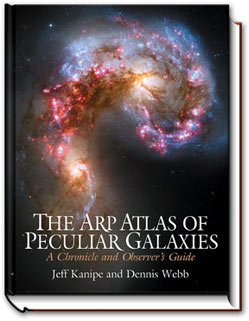
The Arp Atlas of Peculiar Galaxies
A Chronicle and Observer's Guide
In 1966, astronomer Halton Arp compiled
his Atlas of Peculiar Galaxies, which
featured 338 images of some of the
strangest looking galaxies and galaxy
groups then known to exist. The
purpose of the Atlas, Arp stated in his
preface, was to graphically present
structural peculiarities in galaxies "in
order to build a realistic picture of what galaxies are
really like." At the time, astronomers were struggling to formulate a workable taxonomy of "symmetrical"
galaxies using classification schemes such as Edwin Hubble's tuning fork diagram. But the Atlas was comprised of the
"Elephant Men" of galaxies, and their deformations challenged and defied astronomers' attempts at galaxy classification.

Although the Atlas itself has been long out of print, this book not only reproduces all 338 of the original Atlas of Peculiar Galaxiesimages, including Arp's preface, it also
presents new images of all Arp galaxies taken by amateur astronomers, along with finder charts and observing notes. In addition, it provides a chronicle of Arp's saga, from
his early work at Mount Wilson and Palomar, where the original Atlas was assembled, to his controversial
research on discordant redshifts. Although Arp's astrophysical interpretations have sparked controversy among
his peers - the giants of professional astronomy - his story has stoked the interests of amateur astronomers
throughout the world who want to know more about the man and
his catalog of peculiar galaxies.
In addition to Arp's story, the book also provides amateurs with a
complete guide to observing the Arp galaxies. Today, even with the
advent of large-aperture amateur telescopes and affordable CCD cameras, this is admittedly an ambitious undertaking, but the
Observing Guide will help put many of these unusual galactic specimens within reach of both observers and imagers. Even with
8 and 10-inch telescopes, the peculiarities of nearly 20 Arp galaxies can be detected. Whatever size telescope you have, however, the
point is not to just look for an Arp galaxy, but to observe the unusual structures produced by galactic interactions, gravitational
tidal forces, and inherent dynamics. To help you identify these structures, the guide provides detailed diagrams of each Arp field.
What can you see? Counter-tails, rings, jets, "wind"
effects, plumes, galaxy chains, single- and multi-armed
galaxies, and other oddities. Such features may task your imaging and observing skills, but they
are what make the Arp galaxies so intriguing. Observers seeking new challenges, a good story,
and an important piece of astronomy history need look no further than The Arp Atlas of
Peculiar Galaxies: A Chronicle and Observer's Guide.
THE CHRONICLE INCLUDES:
- The processes that make galaxies peculiar
- Halton Arp's early life
- His initial work at Mount Wilson and Palomar
- How and why he constructed the Atlas
- Why he left the Carnegie Institute
- The breakup between Carnegie and Caltech
- His controversial work on galaxy-quasar associations
- Profiles of some of Arp's most prominent discordant redshifts cases
THE OBSERVER'S GUIDE INCLUDES:
- A detailed guide to observing the Arp peculiar galaxies
- 26 sky charts showing the locations of the Arp galaxies by region
- Detailed tables for each sky chart
- Amateur images of all 338 Arp galaxies
- Annotated schematic diagrams of each galaxy field
- Galaxy characteristics and visual observation narratives
- Arp's explanatory notes from the Atlas

ADDITIONAL LINKS:
- Author's Note [ PDF ]
- Table of Contents [ PDF ]
- Preface [PDF]
- Making a Peculiar Galaxy [ PDF ]
- Sample of Original Arp Atlas as repoduced in this volume [ PDF ]
- Sample pages from Observing Guide section [ PDF ]